
Polished Yoshino Logs
磨き丸太 — Migaki Maruta | A 600-Year-Old Craft, Still Made the Same Way.
Logs That Predate the Samurai and Outlast Trends
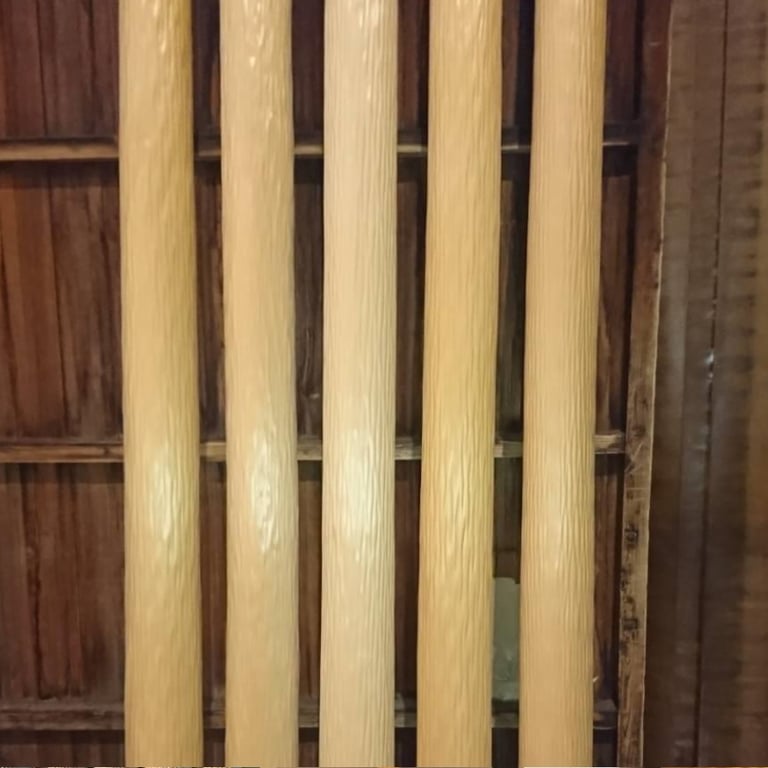
Polished logs (migaki maruta) are said to have originated in the Muromachi Era, around 1400 AD. For over six centuries they have been used as architectural pillars in Japan's most refined spaces: temples, traditional tea rooms, tokonoma alcoves in historic ryokan. The craft is still practised by the Morisho Meiki, whose family has refined it for over one hundred years in the Yoshino mountains.
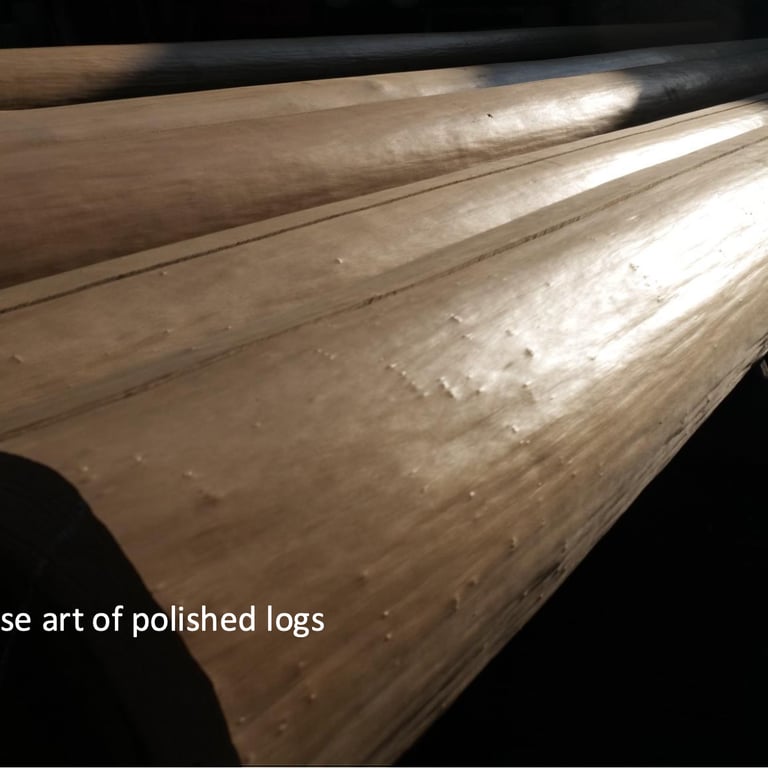
The process cannot be shortcut. Yoshino Kitayama trees are nurtured through four seasons. In mid-winter, the bark is carefully peeled and the log is exposed for 180 days of natural drying. The Yoshino climate and drying time are inseparable from the result. This is finished with 24 hours in a specially built clay-walled kiln. The luster that develops is not a surface treatment. It is a property of the wood itself, produced by the balance of natural and kiln drying, deepening further as the log ages in a finished interior.
Each log has a traditional slit along its back, a technique used for hundreds of years to prevent surface cracking in softwoods after installation. It is not a defect. It is craft knowledge that most modern suppliers have forgotten.
Enquire About Polished Logs
Tell us your style, volume, and destination. We'll respond within two business days with availability, indicative pricing, and lead time.
Phone / WhatsApp
+81 80 5744 6446
Email:
grahams@north21.co.nz
Phone / WhatsApp:
+818057446446
Head Office:
St Heliers, Auckland, New Zealand 1071
Japan Office:
Ieyama, Kawane-Cho, Shimada Shi 428-0104
© Copyright 2026 North21 Limited